Discover how service-based franchises in Canada grow with smarter territory mapping, demographic analysis, and data-driven expansion.
TL;DR — Key Takeaways
- The Canadian service business sector is expanding rapidly due to low entry costs, aging demographics, and consumer demand for convenience.
- Service franchising offers strong growth potential but requires strategic territory planning to avoid overlap and inefficiencies.
- Smappen enables Canadian franchises to design data-driven territories, analyze demographics, and unlock white-space opportunities. Similarly, would opening a location here cannibalize sales from other locations?
The Canadian Service Business Boom
If you look closely at Canada’s economic landscape, you’ll notice something powerful happening: service-based models are accelerating.
Home services. Senior care. Cleaning. Automotive repair. Business support. Education. Fitness.
Consumers are outsourcing more than ever before. Convenience is king. Time is scarce. Specialized expertise wins.
Service franchises, in particular, are gaining traction because they offer:
- Lower startup costs compared to retail or restaurant franchises
- Mobile or home-based operating models
- Scalable systems supported by a parent brand
This isn’t a passing trend. It’s structural.
Statistical Snapshot: Service Business Franchising in Canada
- Franchising is a major economic engine in Canada, contributing over $120 billion to GDP and employing nearly 2 million people nationwide.
- Service-based franchises represent one of the fastest-growing segments of the franchise ecosystem.
- Low infrastructure requirements make service franchises more accessible to new entrepreneurs.
- Canada’s rapidly aging population — expected to approach 25 % seniors by 2035 — is driving sustained demand for home care, wellness, and support services.
- Consumers increasingly favor convenient, personalized services — particularly those delivered at home — accelerating demand for service-based franchise models.
These macro factors create fertile ground for expansion — but expansion without structure can create chaos.
Why Service Business & Franchising Is Growing Faster Than Ever
Several forces are driving this momentum:
1. Lower Barriers to Entry
Unlike restaurants or retail chains, many service franchises don’t require expensive storefronts or large inventories. That makes them attractive to first-time entrepreneurs.
2. Demographic Shifts
Canada’s aging population directly increases demand for home-based and assistance services.
- 18.8% of Canadians were aged 65+ in 2022
- The share of seniors will continue increasing in the coming decades.
Statistics Canada demographic data cited in franchise industry reports : https://www.statcan.gc.ca/en/start
The Canadian home care services market alone is projected to exceed $15 billion by 2035, reflecting the massive demand created by an aging population. Source
3. Digital Transformation
Online booking, CRM systems, and digital marketing allow service franchises to scale geographically without massive overhead.
4. Resilience
Essential services — maintenance, home care, repair — remain in demand even during economic downturns.
But here’s the catch.
Service businesses don’t rely on foot traffic. They rely on territory efficiency.
💡 Canada’s franchise ecosystem is both mature and expanding. The country counts more than 1,200 franchise brands and over 76,000 franchised locations, spanning dozens of industries. At the same time, structural trends are accelerating the growth of service-based concepts. Demographics are a major factor: nearly one in five Canadians is already over 65, fueling long-term demand for home care, wellness, and support services. In fact, the Canadian home care services market alone is projected to exceed $15 billion by 2035, highlighting the scale of the opportunity for service-driven franchise models.
These macro trends create a strong opportunity for service-based franchises.
But scaling a service network across territories requires careful geographic planning.
The Critical Role of Territory in a Service Based Business
Territory Definition and Franchise Disclosure Requirements in Canada
The first important aspect of territory planning in a service-based franchise is the legal framework surrounding franchise disclosure in Canada. In several provinces, franchise systems are required to provide a Franchise Disclosure Document (FDD) before a franchise agreement can be signed. This document outlines essential information about the franchise system, including fees, obligations, financial performance representations, and often the structure of the franchise territory itself.
Currently, six Canadian provinces have franchise disclosure legislation: Ontario, Alberta, British Columbia, Manitoba, New Brunswick, and Prince Edward Island. These laws require franchisors to deliver an FDD to prospective franchisees at least 14 days before signing the franchise agreement or receiving any payment. The goal is to ensure transparency and allow potential franchise owners enough time to assess the opportunity.
Other provinces — including Quebec, Saskatchewan, Nova Scotia, Newfoundland and Labrador, and the northern territories — do not currently have specific franchise disclosure legislation. However, franchise relationships in those regions are still governed by broader principles of contract law and good faith obligations.
Because the territory is often one of the most critical elements of a service-based franchise agreement, clearly defining it in the FDD is essential. Franchisees need to understand whether their territory is exclusive, protected, or simply a suggested operating area, and how expansion, digital sales, or additional franchise units might affect it. For franchisors expanding across Canada, using territory mapping tools to design and justify territories can help ensure that disclosure documents align with real market potential and operational realities.
Defining Efficient Territories for Service-Based Businesses
For a restaurant, location matters.
For a service business, territory matters more.
Because technicians travel. Teams dispatch. Vehicles consume time and fuel.
If a territory is:
- Too large → operational inefficiency
- Too small → limited revenue potential
- Poorly structured → internal franchise conflict
That’s where territory mapping becomes essential.
From Market Opportunity to Territory Intelligence
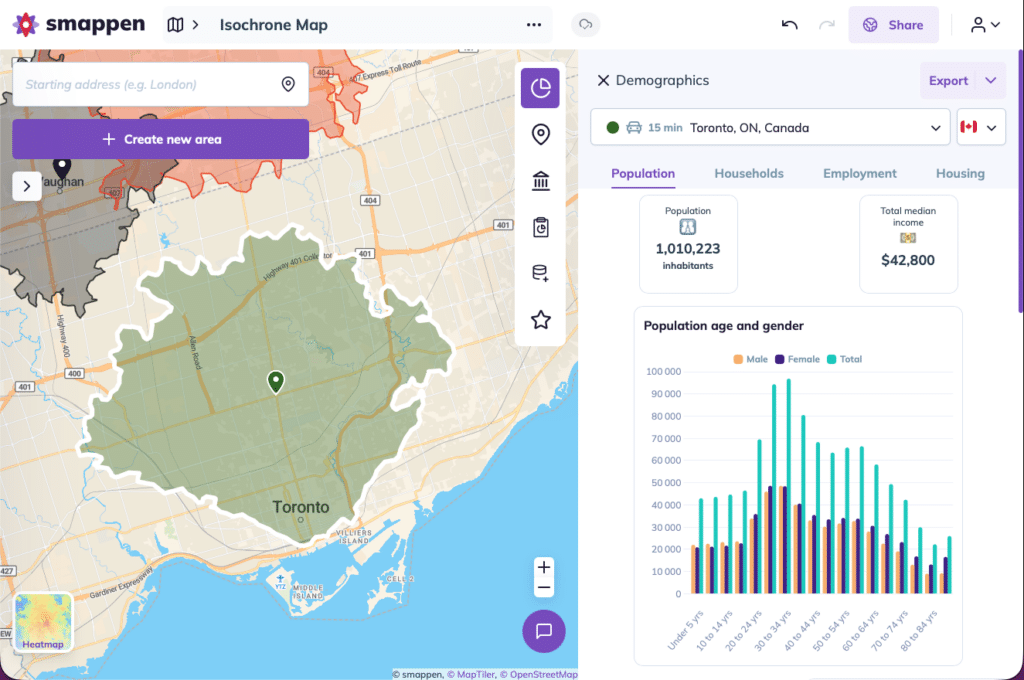
Smappen allows franchises to:
- Create isochrone zones based on real travel time
- Design isodistance territories
- Use administrative boundaries
- Draw custom service areas
- Analyze population and income data
- Identify competitors and points of interest
- Import internal business data
Instead of asking, “Does this region feel promising?” you ask:
“How many households within 25 minutes match our target demographic?”
That’s a different level of conversation.
Avoiding Territory Conflict in Growing Networks
As service franchises scale across provinces — Ontario, Alberta, British Columbia, Quebec — clarity becomes vital.
Smappen enables:
- Side-by-side territory comparison
- Overlap detection
- White-space visualization
- Multiple map scenario planning
This protects both franchisees and brand reputation.
Growth should create momentum, not friction.

White Space: The Hidden Growth Lever
One of the most powerful insights in service franchising is identifying underserved regions.
With demographic overlays, you can:
- Detect mid-sized cities with growing populations
- Identify suburban zones lacking service coverage
- Spot high-income neighborhoods with limited competition
Expansion becomes strategic instead of reactive.

Demographic Analysis: Know Who Lives in Your Territory
Not all Canadian regions behave the same.
Some services thrive in:
- Family-heavy suburbs
- High-income districts
- Aging communities
Smappen allows analysis of:
- Population density
- Age brackets
- Income levels
- Household structures
- Socio-economic indicators
You move from assumption to validation.
Using Territory Mapping as a Franchise Sales Tool
Here’s where it becomes powerful for lead generation.
Imagine presenting a prospective franchisee with:
- A clearly defined 20-minute drive-time zone
- Demographic breakdown
- Competitive landscape
- Growth projections
That builds trust.
Data-backed territory proposals accelerate recruitment.
The Future of Service Based Business Expansion in Canada
Canada’s service sector will continue to grow.
But the winners will be those who:
- Understand territory economics
- Use demographic intelligence
- Avoid operational sprawl
- Expand with precision
Territory mapping isn’t optional anymore.
It’s infrastructure.
Conclusion
The Canadian service based business sector is expanding, fueled by demographic shifts, digital tools, and consumer demand for convenience.
Franchise networks that combine this macro opportunity with territory intelligence gain a decisive advantage.
Smappen empowers service franchises to:
- Design optimized territories
- Analyze demographic potential
- Detect white space
- Prevent internal overlap
- Scale confidently across Canada
And Smappen makes territory mapping affordable for service franchises!
Growth favors the prepared.
From customers, with love
Explore real use cases and get inspired by our customer stories to know what you can achieve easily with Smappen.
FAQ's - Service Business and Franchising in Canada
Service businesses travel to customers. Travel time, coverage density, and demographic distribution directly impact profitability.
It enables networks to create, visualize, and analyze territories using travel-time zones, distance zones, and demographic data.
Yes. By comparing coverage zones with demographic data, businesses can detect white space and growth opportunities.
Yes. Multiple maps can be created and managed for different regions and scenarios. Smappen covers all Canada province with up-to-date data relied. You can also create your maps for the US market.