
Key takeaways - Demographic Map Data
- Customer demographic mapping means placing your existing customers on a map, attaching the demographics of the areas they live in, and using that profile to find similar areas.
- An effective method has five steps: geocode your customer list, choose a geographic unit, add official demographic data, build a customer index, and target lookalike areas.
- In the U.S., the most granular free source is the Census Bureau’s American Community Survey (ACS) 5-year estimates, available down to the block group level.
- A customer index compares the share of your customers in a segment with that segment’s share of the local population. An index above 100 means over-representation.
- Demographics describe where likely customers live, not whether a site will succeed: combine them with competition, access and daytime population before you decide.
Most businesses know how many customers they have. Far fewer know who those customers are, and where more people like them live. That gap is why two stores with identical foot traffic can perform very differently.
Demographic map data closes that gap. You start from your own customer list rather than a blank map, profile it against official census data, and end up with a shortlist of areas that match your best customers.
This guide walks through the five-step method, the data sources to use in the U.S., UK, Canada and Australia, and the mistakes that most often distort the results.
What is demographic mapping?
Demographic mapping is the process of linking population characteristics (age, household income, household type, housing tenure, employment) to specific geographic areas, so you can see how those characteristics vary across a territory.
Demographic map data comes in two forms, and each answers a different question:
| Area demographic mapping | Customer demographic mapping | |
|---|---|---|
| Starting point | A zone you draw (radius, drive time, ZIP codes) | Your customer list (CRM, POS, loyalty data) |
| Question answered | “Who lives here?” | “Who buys from us, and where are more people like them?” |
| Typical output | Population and income profile of one area | Customer index and ranked list of lookalike areas |
| Best for | Evaluating one site or territory | Choosing where to expand, advertise or draw territories |
The rest of this guide focuses on customer demographic mapping. Area mapping is one of its steps.
How to map customer demographics effectively (5 steps)
To map customer demographics effectively, geocode your customer addresses, assign each one to a small geographic unit, attach official demographic data to those units, compare your customer mix with the overall population, and use the result to rank lookalike areas.
Step 1 – Start from your customer data
Export customer addresses (or ZIP/postal codes at minimum) from your CRM, POS or loyalty program. Remove duplicates and test accounts, then geocode the addresses, that is, convert them to latitude/longitude so each customer becomes a point on the map.
Keep a simple value field: revenue, visit frequency or lifetime value. It lets you weight your best customers more heavily later.
Step 2 – Choose the right geographic unit
The unit you aggregate customers into determines how precise your profile will be.
| Unit | Precision | When to use it | Watch out for |
|---|---|---|---|
| Census block group (U.S.) / Output Area (UK) / Dissemination Area (CA) / SA1 (AU) | High | Profiling customers precisely | Higher margins of error on survey-based variables |
| Census tract (U.S., CA) / MSOA (UK) / SA2 (AU) | Medium | Balancing precision and reliability | Can mask contrasts within urban neighborhoods |
| ZIP code / postcode | Medium–low | Matching direct-mail or ad targeting | Boundaries follow postal routes, not communities |
| Drive-time or radius zone around a site | Site-specific | Evaluating a store’s catchment area | Hard to compare across sites of different density |
Step 3 – Add demographics from official sources
Attach demographic variables to each unit using national statistics agencies, not scraped or modeled data you can’t trace.
| Country | Source | Latest release commonly used |
|---|---|---|
| United States | U.S. Census Bureau, American Community Survey (ACS) 5-year estimates | 2020–2024 |
| United Kingdom | Office for National Statistics (ONS) / National Records of Scotland | Census 2021 (Scotland: 2022) |
| Canada | Statistics Canada | Census 2021 |
| Australia | Australian Bureau of Statistics (ABS) | Census 2021 |
According to the U.S. Census Bureau, the ACS samples roughly 3.5 million addresses each year. Its 1-year estimates are only published for areas with 65,000+ people, while 5-year estimates cover all areas down to census tracts and block groups. For customer mapping, that makes the 5-year estimates the default choice.
Step 4 – Build a customer demographic index
This is the step most guides skip, and the one that turns a map into a decision. For each demographic segment, compare the share of your customers in that segment with the segment’s share of the population in your market:
Index = (% of customers in segment ÷ % of population in segment) × 100
Illustrative example: suppose 42% of your customers live in block groups where median household income exceeds $100,000, but only 18% of the metro’s population lives in such block groups. Your index for that segment is (42 ÷ 18) × 100 ≈ 233: customers from those areas are over-represented about 2.3 times.
An index near 100 means no difference. An index under 80 signals an under-represented segment.
Run the index on 4 to 6 variables: income band, age band, household type, owner vs. renter, education. Keep the two or three with the strongest over-representation. That is your customer profile.
Step 5 – Find lookalike areas and act
Score every unit in your target market by how closely it matches the profile, then rank the results. The top-scoring areas without an existing location or strong competitor become your shortlist for new sites, franchise territories or local marketing.
Before committing, check each shortlisted area against three factors that demographics alone don’t capture: competitor density, access (roads, parking, transit) and daytime population. In the U.S., the Census Bureau’s LODES data shows where people work, not just where they live.
Want to run these five steps without a GIS team? Smappen lets you import your customer list, overlay official census data and compare areas side by side.
How franchisors, retailers and marketers use customer demographic mapping
Site selection
Retailers use customer demographic mapping to shortlist locations where the population matches the profile of their best existing customers. Instead of asking “Is there traffic here?”, they ask “Do enough people like our customers live within a 10- or 15-minute drive?”. The drive-time zone around each candidate site is then compared against the profile from Step 4.
Franchise territory design
Franchisors use customer demographic mapping to size territories so each one holds a comparable number of target households, not just a comparable area. A territory built around the customer profile gives every franchisee a similar starting potential. It is also easier to explain to candidates and to document in the territory section of a franchise disclosure document.
Targeted marketing
Marketers use customer demographic mapping to spend local media budgets only where lookalike households are concentrated. Ranking ZIP codes or postcodes by their match to the customer profile turns a broad direct-mail, door-to-door or geo-targeted ad campaign into a shortlist of priority areas.
5 mistakes that skew demographic maps
Most demographic mapping errors come from the data, not the map: small-area uncertainty, mixed sources, and confusing where people live with where they shop.
- Ignoring margins of error. ACS estimates are published with margins of error at a 90% confidence level. For small block groups, a variable can carry a wide range, so don’t rank areas on differences smaller than the margin.
- Mixing vintages or sources. Comparing a 2021 census variable with a 2024 survey estimate, or U.S. and Canadian incomes without adjusting for currency, creates false contrasts.
- Profiling on too few customers. An index built on a few dozen customers is noise. Aggregate to larger units or longer periods until each segment holds enough customers to be meaningful.
- Using residential data for daytime businesses. A lunch concept near an office park depends on who works there, not who lives there.
- Treating correlation as a guarantee. A strong demographic match raises the odds of success. It doesn’t replace competition analysis, unit economics or operator quality.
Doing it with Smappen
Smappen is a territory mapping platform built for franchisors, retailers and marketing teams who don’t have GIS expertise. For the method above, it covers:
- Step 1: import customer lists from a file or through the native HubSpot integration.
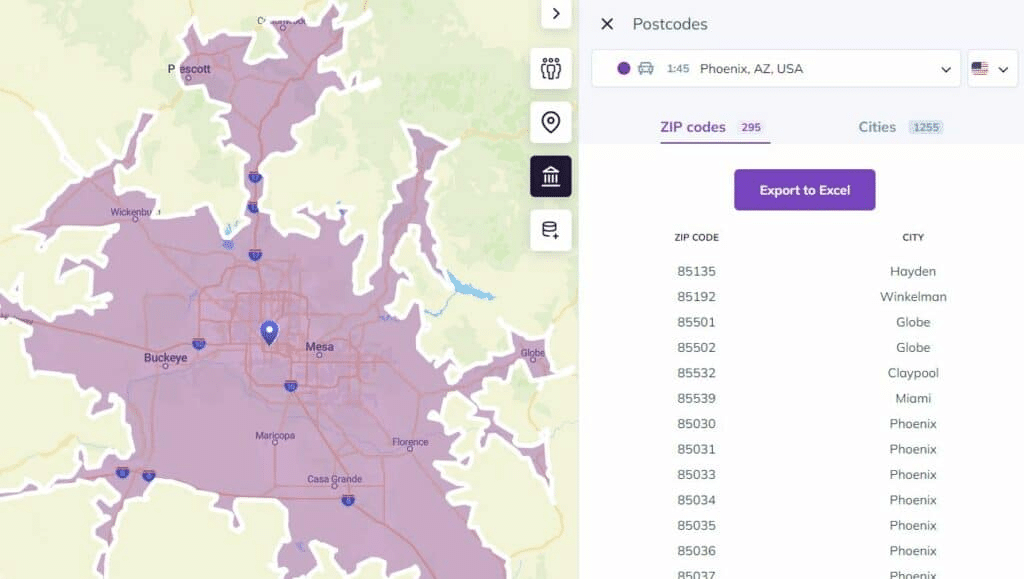
- Steps 2–3: draw drive-time, radius, ZIP code or custom zones with official demographic data built in: U.S. Census Bureau ACS 5-year (2024), ONS Census 2021, Statistics Canada Census 2021, ABS Census 2021. See the full data catalog.
- Step 5: compare areas side by side and export branded reports or ZIP code lists to share with franchisees or media partners.
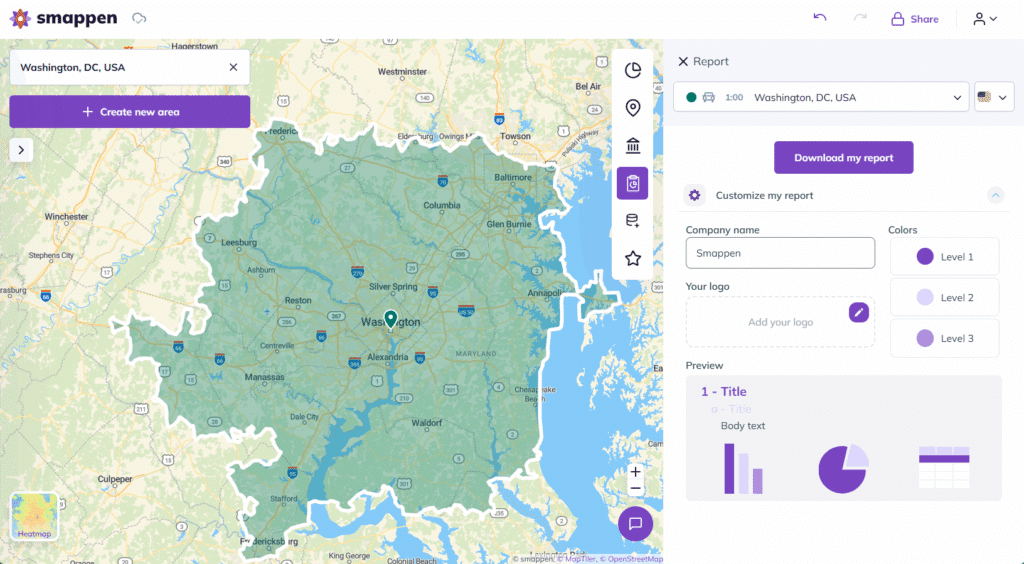
Step 1 – Define your area
You begin by drawing a zone in Smappen. Options include:
A simple radius from a point (e.g., 5 miles around a store)
A “drive-time” polygon (how far someone can drive in 10/15/30 minutes)
- Administrative boundaries (ZIP codes, counties etc)
- Or even custom shapes you draw manually (great for irregular territories)
Step 2 – Tap into the demographic data
Once your zone is defined, you go to the”Demographics” panel in Smappen. You’ll access metrics such as: number of people, age breakdowns, gender split, median income, household types, housing tenure and more.
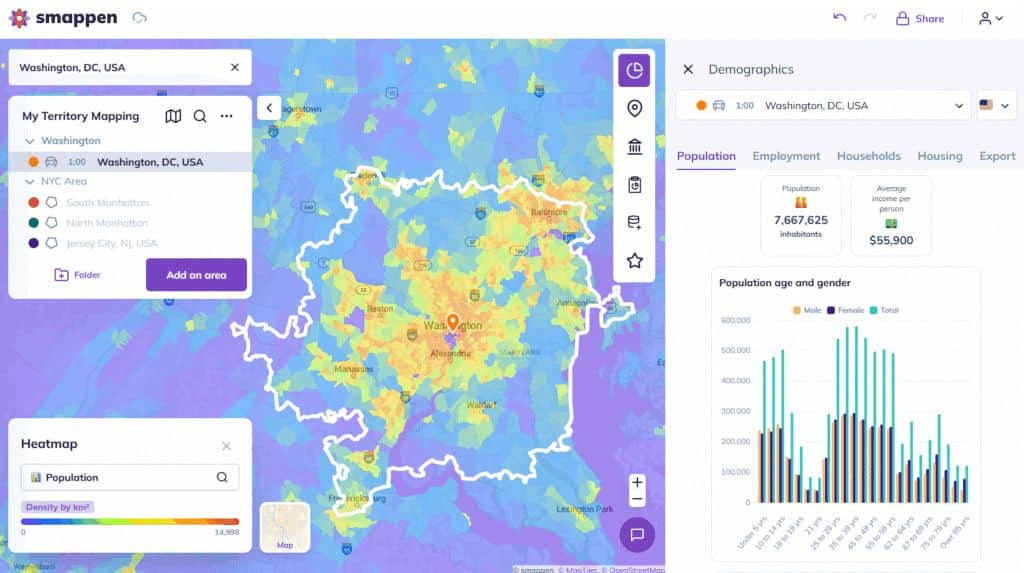
Step 3 – Visualize & act on the insights
Smappen isn’t just data in a spreadsheet—it lets you layer heatmaps (e.g., income density, population clusters) on top of your map.
Then you review: Are there un-served pockets of high-income households? Are you drawing territory lines that overlap with existing stores? Is the site reachable by major roads?
Once you’ve examined that, you can export reports, share with your team or franchisees, and make data-backed decisions.
For Marketers
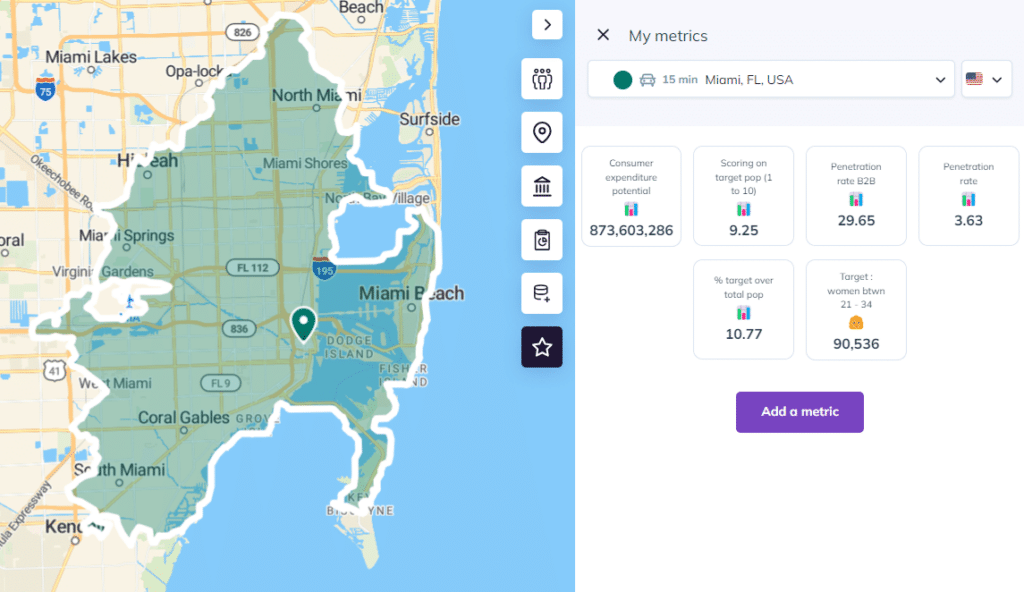
You’re running regional campaigns and want to target the right neighborhoods. Instead of blanket mailers or wide-net ads, you can focus only on zones with ideal demographics: e.g., households with age 25-34 earning >$75k, within 10 minutes of key locations. Smappen makes targeting much smarter.
Plus, you can visualize where your “best” customers live and identify similar zones you haven’t tapped yet.
For Franchisors
Scaling a franchise means creating territories that are equitable, manageable, and have clear opportunity. With demographic map data you map and compare territories by population, income, households and drive time—ensuring each franchisee starts with a viable market. Smappen even supports exporting zone data for your franchisees.
It also helps avoid cannibalization and overlap by clearly delineating areas based on actual data.
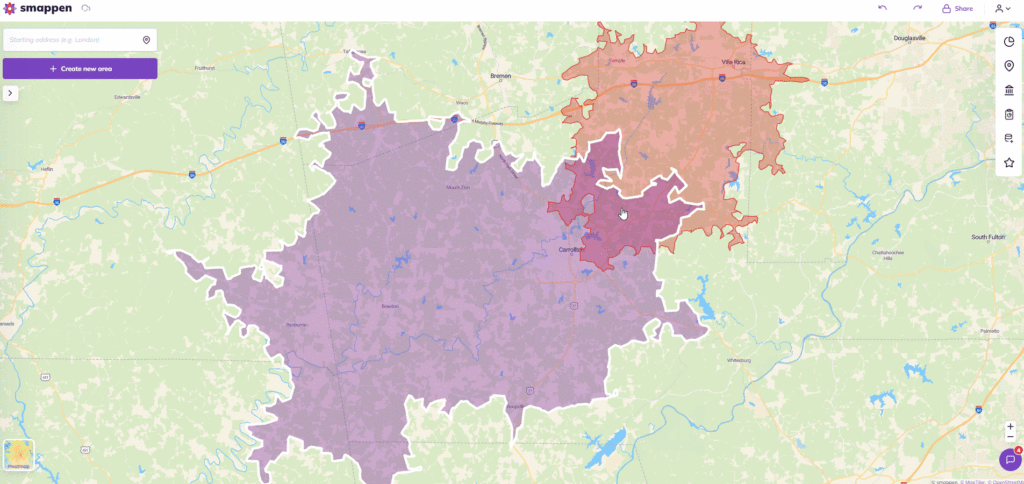
How to Use Demographic Map Data for Strategic Advantage
Let’s explore three concrete use-cases where you can deploy this feature immediately.
Use-Case 1: Optimizing Store Location
Imagine you’re planning your next retail store in the U.S. Start by plotting a 30-minute drive-time area around a candidate site in Smappen. Then check:
Total population in that zone
Household income levels
Age and family composition
Housing tenure (owners vs renters)
If the numbers check out (e.g., strong population, target income, correct household types), you move ahead. If not, you either refine the boundary, choose a new site, or do additional investigation.
Use-Case 2: Designing Franchise Territories
As a franchisor you’re dividing a state into territories. In Smappen you draw multiple polygons, assign each a drive-time or population target, then pull demographic stats for each. You ensure:
Each territory has comparable population or income potential
No major overlap between adjacent territories
Accessible drive-times for the franchisee
You then export the territory maps with data and share with your franchisees.
Use-Case 3: Targeted Marketing & Media Planning
You’re launching a direct mail, digital ad, or field marketing campaign.
Using Smappen you:
Create zones around candidate neighborhoods (radius or drive-time)
Pull demographic data for those zones (age, income, households)
Rank zones by “target fit” (highest density of your ideal customer)
Export the ZIP codes or map layers and feed them into your ad platform or mailing list
Monitor results and adjust zones next iteration
This way your budget is spent where your audience lives, not where you hope they are.
Start with your customers, not the map
The most useful demographic map doesn’t start with a blank territory: it starts with your customers. Profile who already buys from you, measure which segments are over-represented, then look for more of them. Everything else, from site selection to franchise territory design to ad targeting, follows from that profile.
FAQ's - Demographic Map Data
How do you map customer demographics?
Geocode your customer addresses, assign each customer to a small geographic unit such as a census block group, and attach official demographic data to those units. Then compare your customer mix with the local population to see which segments are over-represented, and use that profile to rank lookalike areas.
What data do I need to map customer demographics?
You need customer addresses or postal codes from your CRM or POS, plus area-level demographic data from an official source. In the U.S. that is typically the Census Bureau’s American Community Survey 5-year estimates. In the UK, Canada and Australia, it is the most recent national census.
What is the best geographic level for customer demographic analysis?
The smallest unit with reliable data: census block groups or tracts in the U.S., Output Areas in the UK, Dissemination Areas in Canada, SA1s in Australia. Use larger units, such as tracts or ZIP codes, when you have few customers or when small-area estimates have wide margins of error.
What is a customer demographic index?
A customer demographic index compares the share of your customers in a demographic segment with that segment’s share of the population, multiplied by 100. An index of 150 means the segment is 1.5 times more common among your customers than in the market.
Is demographic map data free?
Official demographic data is free: the U.S. Census Bureau, ONS, Statistics Canada and the ABS all publish it at no cost. What you pay for in a mapping tool is the time saved on geocoding, joining data to boundaries, and drawing and comparing custom zones.
Can demographic mapping predict whether a location will succeed?
No. It shows where people who resemble your customers live, which improves the odds, but results also depend on competition, access, daytime population, rent and execution. Use demographics as the first filter, not the final decision.