
TL;DR - Travel Time Mapping in Australia
- Travel time maps show how far people can travel within a chosen time, making them far more practical than simple radius maps for Australian businesses and everyday users.
- Smappen lets users create travel time maps based on driving, cycling, walking, and other transport modes.
- For entrepreneurs in Australia, travel time mapping helps with smarter site selection, delivery planning, local marketing reach, and customer accessibility analysis.
Travel Time in Australia: Why Smappen Is Changing the Way We Plan Movement
Australia is a big country. When it comes to business, commuting, and location planning, that vastness changes everything. In Australia, distance alone tells only half the story. Ten kilometres in inner Sydney is not the same as ten kilometres in regional Queensland. That’s exactly where travel time maps become wildly useful—and where Smappen steps into the spotlight.
A travel time map doesn’t simply draw a neat circle around a place like a child armed with a compass and too much confidence. Instead, it calculates how far someone can actually go in a chosen amount of time, based on roads, transport type, and real movement logic. Smappen’s platform is built precisely for this purpose: helping users create territories based on travel time, isochrones, and mapped accessibility zones.
For Australian entrepreneurs, that’s gold. Whether you’re opening a café in Melbourne, launching a plumbing service in Brisbane, or figuring out delivery coverage in Perth, travel time matters more than raw kilometres ever could.
What Is a Travel Time Map, Really?
Let’s strip away the jargon for a moment. A travel time map is a visual representation showing how far a person can travel from one starting point within a specific amount of time. Say you set 20 minutes by car from central Adelaide. Smappen calculates the reachable area based on actual road networks—not imaginary straight lines through rivers, parks, buildings, or somebody’s backyard fence.
These maps are also called isochrone maps. Smappen specifically defines them as travel-time areas built around transport logic such as car, bicycle, walking, and more. That means they reflect reality far better than classic radius circles.
Why Travel Time Matters More in Australia
Australia presents a peculiar geographic paradox: massive open land, but heavily concentrated urban populations. In dense urban corridors like Sydney or Melbourne, congestion can make a short drive painfully long. Meanwhile, in regional centres, longer distances may actually mean faster travel.
That’s why entrepreneurs here need travel time analysis more than generic maps. If your target customer base is “within 15 minutes,” Smappen helps identify exactly where those people are located—not where they seem to be on paper.
For local businesses, this changes everything:
- Retail catchment zones become accurate
- Delivery boundaries become realistic
- Service appointments become efficient
- Franchise territories become balanced
In short: no more guessing. No more “it looked close on GMaps.”
How Smappen Builds Travel Time Maps
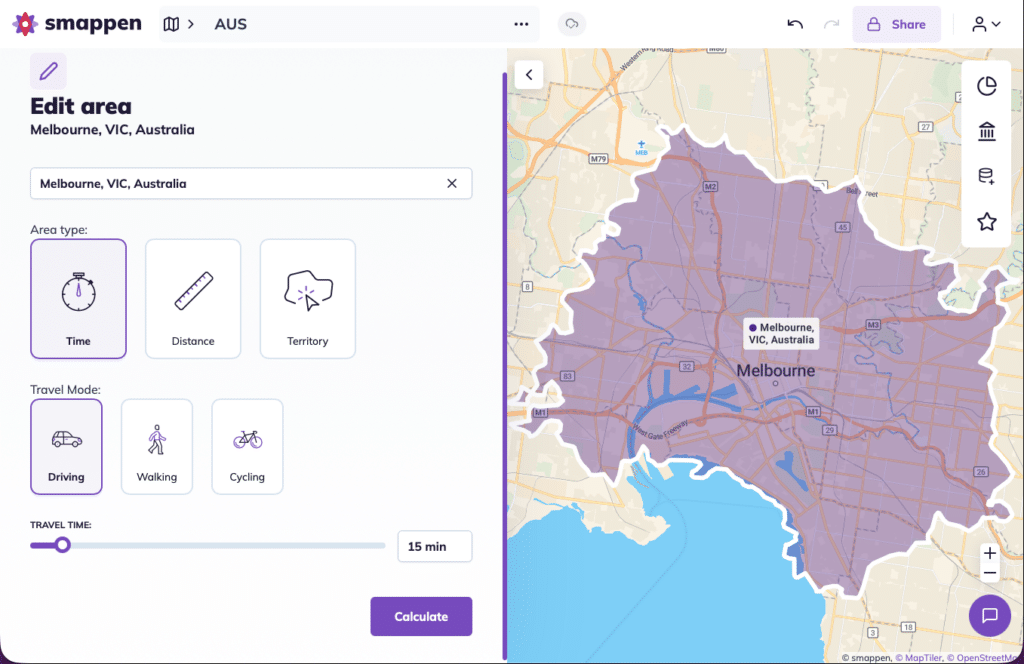
Smappen’s system allows users to enter a starting address, choose a transport method, set travel duration, and instantly generate a mapped travel zone. According to Smappen, its tool factors in criteria like road types, speed conditions, and transportation mode to determine reachable zones.
That means:
- Car routes reflect road speeds
- Walking maps reflect pedestrian pathways
- Cycling considers route access
- Public transport options may include timetable logic depending on mapping mode
Travel Time Maps for Australian Entrepreneurs
If you run a business in Australia, travel time maps are not just nice-to-have visual candy—they’re strategic decision tools.
Imagine:
You own a mobile dog grooming business in Newcastle. You can only service clients within 25 driving minutes per appointment slot. Smappen helps define exactly which suburbs fit that time threshold.
Or:
You’re opening a fitness studio in Brisbane. Rather than choosing a suburb based on rent alone, you use Smappen to identify areas where the highest number of potential members can reach you in under 15 minutes.
Best Use Cases for Smappen Travel Time Mapping
1. Choosing New Business Locations
Opening a second store? Don’t just pick a suburb because it “feels promising.” Smappen helps assess how many people can realistically reach that site within chosen travel times.
2. Delivery Zone Optimisation
Restaurants, florists, couriers, grocers—delivery margins depend on route efficiency. Travel time maps help draw sustainable delivery boundaries.
3. Franchise Expansion Planning
Franchise operators can define balanced territories using consistent time-based access zones rather than uneven postcode splits.
4. Marketing Campaign Targeting
Smappen notes that users can align territory mapping with targeted campaigns by defining real service areas or export postcode list of a travel-time zone.

5. Service Technician Routing
Electricians, plumbers, cleaners, pest control—field teams save time when territories are based on drive-time zones.
Travel Time vs Distance: The Critical Difference
Here’s the trap many businesses fall into: confusing distance with accessibility.
A location 8 km away may take:
- 9 minutes in Canberra
- 38 minutes in Sydney peak traffic
- 14 minutes in Hobart
- 45 minutes if there’s roadwork and a tractor parade
Distance doesn’t account for:
- Congestion
- Road hierarchy
- Speed limits
- Natural barriers
Travel time does.
That’s why Smappen’s isochrone model is smarter than simplistic radius mapping.
How Easy Is Smappen to Use?
One of Smappen’s biggest strengths is simplicity. Their process is intentionally straightforward:
- Enter a starting point
- Choose travel duration
- Select transport mode
- Generate mapped travel zone
Smappen explicitly describes this as quick, intuitive, and accessible even for users without GIS expertise. That means entrepreneurs don’t need mapping degrees, cartography diplomas, or mystical geographic powers.
Just a browser and a plan.
Conclusion: Travel Time Is the New Business Geography (Especially for Australian Businesses)
The old way of thinking about maps was flat, static, and frankly a bit lazy. Draw a circle, estimate a radius, hope for the best.
But Australia’s geography—and modern business reality—demands smarter tools.
Smappen brings precision to travel time analysis by turning real movement patterns into actionable maps. Whether you’re an entrepreneur planning your next store, a delivery operator shaping service zones, or simply trying to understand customer reach, travel time maps offer clarity where ordinary maps fall short.
In business, time really is money. Smappen just helps you see exactly where that money can go.
FAQ about Travel Time Mapping for Australia
Why is travel time more important than distance in Australia?
In Australia, long distances and varying road conditions make kilometres misleading. A short distance in Sydney traffic can take longer than a much longer regional drive, which is why travel time gives a more realistic picture of accessibility.
What factors affect travel time across Australia?
Travel time in Australia depends on traffic congestion, road types, speed limits, urban density, weather conditions, and whether travel happens in metro, suburban, or regional areas.
Can travel time mapping improve regional business expansion in Australia?
Yes. For businesses expanding beyond major cities, travel time mapping helps identify reachable markets, optimise service zones, and avoid underestimating the impact of remote geography.
Why do Australian entrepreneurs use travel time instead of postcode boundaries?
Postcode boundaries are administrative and often arbitrary for business operations. Travel time zones better reflect how people actually move and access services in real-world conditions.
How do travel time maps help businesses in Australian cities?
Travel time maps help businesses understand how far customers, staff, or deliveries can realistically travel within set time limits, which is especially useful in sprawling metro areas like Melbourne, Brisbane, and Perth.